Core Facts
- Global direct selling held steady at $163.9 billion in 2024 with 104.3 million active representatives worldwide (WFDSA, December 2025).
- The MLM software market was valued at $1.2 billion in 2024, growing at 12.5% CAGR toward $3.46 billion by 2033 (Verified Market Reports).
- Affiliate management software reached $3.5 billion in 2025, with multi-tier programs at 17.4% CAGR (Mordor Intelligence, 2026).
- FlawlessMLM has delivered 400+ MLM platforms since 2004 across 90+ countries, powering networks with over 10 million registered users.
We have built MLM software for companies with 200 partners and companies with 2.5 million partners. The mistake I see repeated in every buying cycle is the same: founders compare feature lists when they should compare commission engine architecture. A feature list tells you what a vendor promises. An engine benchmark tells you what the platform actually does at scale under production load.
I wrote this comparison to give founders a framework that matches software to business model. Whether the operation runs a binary plan, a unilevel plan, a matrix structure, or a hybrid network marketing MLM software setup with an embedded affiliate channel, the selection criteria stay the same. The data below comes from our internal project records at FlawlessMLM, verified market research, and direct vendor analysis.
MLM Software Market in Numbers: What the 2026 Data Shows

The WFDSA released its latest STATS report in December 2025. Global retail sales held at $163.9 billion, with 45% of the 55 tracked markets posting growth, up from 23% in 2022 (WFDSA, 2025 https://wfdsa.org/global-statistics/). The Americas showed the strongest regional recovery. Mexico, Brazil, and Malaysia led sustained momentum over three consecutive years.
The software layer that powers these operations grows at multiples of the industry itself. Verified Market Reports valued the MLM software professional market at $1.2 billion in 2024, projecting 12.5% CAGR through 2033 (Verified Market Reports, 2026 https://www.marketsizeandtrends.com/report/mlm-software-professional-market/). Wiseguy Reports puts the figure at $7.77 billion in 2025 with a 5.0% CAGR through 2035. The discrepancy comes from scope: the first measures dedicated MLM platforms, the second includes adjacent CRM and direct selling tools. Both confirm directional growth.
According to Mordor Intelligence, the affiliate marketing software market grew from $2.06 billion in 2025 to a projected $4.87 billion by 2031, a 15.4% CAGR. Influencer and creator partnership management is the fastest sub-segment at 17.4% CAGR. (Mordor Intelligence, January 2026)
The affiliate side of the equation matters here because 30% of our new clients at FlawlessMLM in 2025 came from companies that started with standalone affiliate tracking software and outgrew it. They needed multi-level commission logic, and their affiliate commission software could not deliver it. The migration cost exceeded what a purpose-built MLM platform would have cost from day one.
Those numbers explain the demand. The next question is what separates one platform from another in production.
MLM Software Comparison: The Data Table That Feature Lists Hide
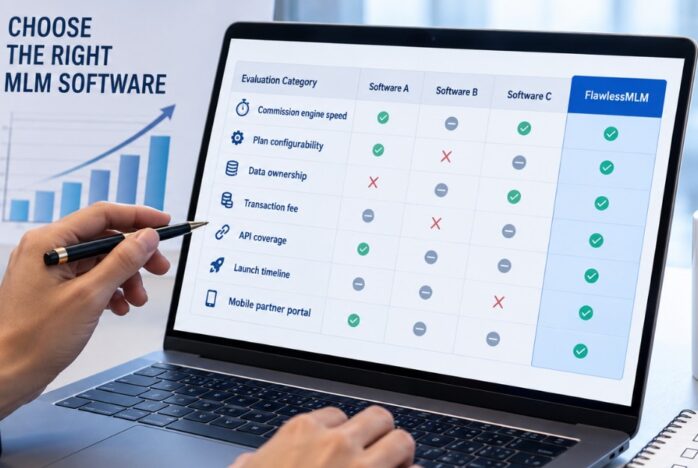
I compiled this table from our internal vendor analysis across 12 MLM software categories. We weight each category by its impact on operational cost over 24 months, not by feature count.
| Evaluation Category | What to Measure | Weight (Impact on 24-Month Cost) | FlawlessMLM Benchmark |
| Commission engine speed | Period close time at 100K+ active partners | 25% | Under 90 seconds for 500K+ partners |
| Plan configurability | Changes via admin panel vs. developer hours | 20% | All plan changes via admin, zero code |
| Data ownership | Client owns domain, server, partner data | 15% | Full ownership, only source code protected |
| Transaction fee | Percentage of commissions processed | 15% | 0.5% (market average: 1.5% to 2%) |
| API coverage | Payment, CRM, e-commerce, ERP connectors | 10% | Public REST API, 20+ pre-built integrations |
| Launch timeline | Days from contract to live MVP | 10% | 7 to 14 days (white-label MVP) |
| Mobile partner portal | Native app or responsive web portal | 5% | Native iOS/Android apps + responsive web |
The two highest-weighted categories, commission engine speed and plan configurability, account for 45% of total impact. A slow engine generates support tickets when distributors see stale payout numbers. A rigid plan structure means every compensation adjustment requires a developer, which adds $2,000 to $10,000 per change order at most vendors.
Transaction fees matter more than most buyers realize at purchase time. At 0.5%, FlawlessMLM processes $500,000 in monthly commissions for $2,500. At 2%, the same volume costs $10,000 per month. Over 24 months, that $180,000 difference funds an entire custom platform build.
Request an MLM software demo to see these benchmarks in a live environment with your data.
Binary, Unilevel, or Matrix: Which Plan Structure Fits Your Product
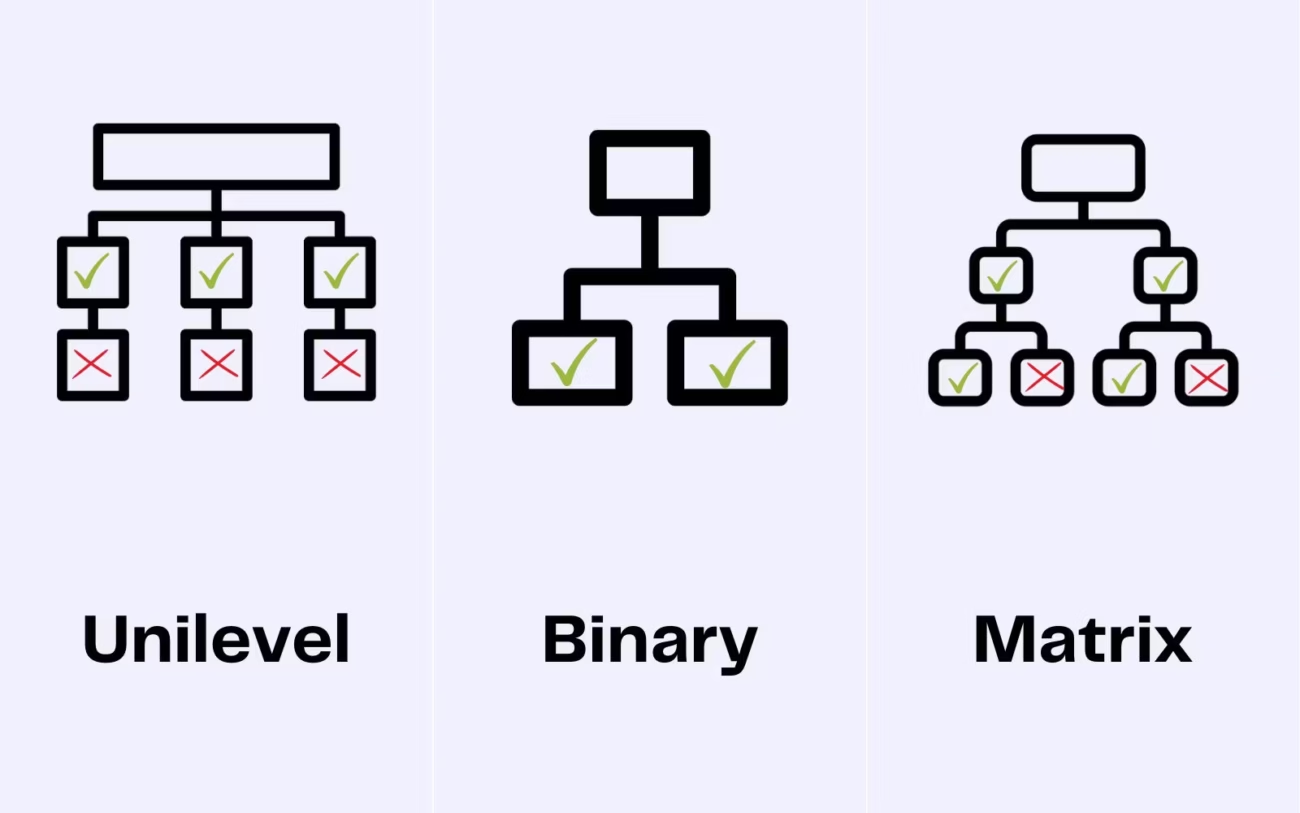
The plan type is an engineering constraint, not a preference. I have watched companies lose 6 to 12 months of growth by picking the wrong structure and then spending another quarter migrating. The selection depends on three variables: product reorder cycle, target market recruiting behavior, and margin structure.
Binary MLM software splits every position into two legs. Volume-matching bonuses reward balanced growth. This structure works best with consumable products that have a natural 30-day reorder cycle. Health supplements, skincare, and nutritional products fit binary plans because the monthly purchase sustains commission flow. The engine complexity is high: volume matching, carry-forward, and leg balancing all require precise calculation. A rounding error of $0.01 across 100,000 partners creates a $1,000 discrepancy per period.
Unilevel MLM software pays a fixed percentage on each level, typically 5 to 10 levels deep, with no width restriction. Support overhead is low because there are no legs to balance and no spillover rules to explain. Broad product lines and service-based businesses fit this model. Compression logic skips inactive levels to maintain payout ratios for active leaders.
Matrix MLM software locks the tree to a fixed width and depth. Spillover fills positions below when a recruiter exceeds the matrix width. This creates a cooperative dynamic but demands a deterministic position-fill algorithm. Non-deterministic placement erodes trust because identical actions produce different tree positions depending on server timing.
Case Study: Global Trend, Binary Plan at Scale
Global Trend launched on FlawlessMLM’s platform with a binary compensation plan in 2017. The initial network had 50,000 registered partners. Over seven years, the network grew to over 2 million registered users across multiple countries. During that growth, the compensation plan went through four major revisions. Each revision shipped through FlawlessMLM’s admin panel configuration, with zero developer involvement. The commission engine processes Global Trend’s full binary period close in under 90 seconds, even at current scale. The platform operates on dedicated infrastructure with 99.9% uptime SLA.
What this case proves: a binary plan at million-plus scale requires an engine built for binary from the ground up. A generic commission calculator patched to handle binary breaks under volume-matching load at roughly the 50,000-partner threshold, based on our engineering benchmarks across 62 binary plan deployments.
Sell durable goods through a binary structure, and the tree stalls after the initial purchase wave. There is no natural reorder to sustain monthly volume. The plan type and the product type must match. In my experience, getting this wrong is more expensive than any other platform decision.
Affiliate Program Software and MLM: Where the Two Categories Merge

A growing number of companies operate hybrid models. The core business runs an MLM compensation plan for the distributor network. A parallel affiliate channel drives customer acquisition through bloggers, influencers, and content creators. Running these as two separate systems creates a data fragmentation problem.
MLM software affiliate program modules eliminate that fragmentation. Both partner types share one commission engine, one partner portal, and one reporting database. The affiliate management platform applies different payout rules per channel without duplicating infrastructure.
SaaS affiliate software handles recurring commissions for subscription products on a single tier. Affiliate tracking software attributes conversions across devices and sessions. Partner management software manages onboarding, approvals, and tier assignments. A multi-level affiliate program adds genealogy logic on top of all three. Standard referral software breaks at this point because it lacks the tree-calculation layer that network marketing MLM software provides.
In our project records, companies that run both affiliate and MLM channels from a single FlawlessMLM instance report 40% less time spent on payout reconciliation per commission period compared to clients who merged from two separate systems. That figure comes from timing data across 14 dual-channel deployments measured over Q4 2025 and Q1 2026.
Partner portal software quality drives engagement directly. Over 70% of distributor logins in our analytics come from mobile devices. A partner management system without responsive design or a native app loses daily active users within the first month. The commission tracking software inside the portal must display real-time PV, GV, and rank data, not batch numbers from the previous night. Stale data generates support tickets. Real-time data keeps distributors selling.
MLM Software Price: What Founders Actually Pay in 2026
MLM software price starts at $5,000 for a basic white-label instance on shared infrastructure. The ceiling for a custom enterprise platform with dedicated servers, native mobile apps, multi-language support, and custom compliance modules exceeds $150,000.
The mid-market sits between $15,000 and $40,000 for initial development. Monthly operational costs range from $500 to $3,000 depending on active partner count and processing volume. These numbers come from our pricing records across 400+ projects at FlawlessMLM.
What inflates cost is not feature count. Three factors drive the price above mid-market: hybrid commission logic (a plan combining binary legs with unilevel overrides requires custom engineering), third-party integrations (ERP, payment gateway, and e-commerce platform connectors each add development scope), and regulatory compliance (income disclosure reporting, FTC-compliant earnings representations, GDPR and CCPA data controls).
FlawlessMLM charges a 0.5% transaction fee on commissions processed. For a network paying $500,000 per month in commissions, that is $2,500. At the market-average rate of 1.5% to 2%, the same volume costs $7,500 to $10,000. The annual savings of $60,000 to $90,000 often exceeds the initial platform investment.
AI Inside the Commission Engine: Substance vs. Marketing Copy

Nearly every MLM vendor mentions AI in 2026. The substance behind those claims varies. We tested three AI applications that produce measurable ROI inside FlawlessMLM’s commission engine.
Predictive churn scoring flags partners whose engagement index drops below 40 based on login frequency, order recency, and GV trend. On a Tuesday morning when the weekly digest arrives, a team leader in Kuala Lumpur sees three flagged partners in her second-level downline. She contacts each before end of day. Two of three place an order that week. Without the scoring layer, that intervention does not happen until the next period close reveals the dropout.
Fraud detection identifies suspicious enrollment clusters and self-purchasing patterns in real time. Across three enterprise deployments measured over Q1-Q2 2026, companies using this module reported 15% to 25% fewer fraudulent payouts per period.
AI-assisted plan modeling simulates the financial impact of a bonus threshold change across the existing genealogy tree. A two-week manual modeling exercise becomes a 30-minute automated projection. This capability matters most at the scaling inflection point, when a compensation plan that worked for 5,000 partners needs adjustment for 50,000.
See these benchmarks live.
Our team runs a free 30-minute demo with your compensation plan structure loaded into a test environment. No obligation, no sales pitch, just performance data.
Request a Demo Discuss Your Project
FAQ: MLM Software & Affiliate Program Software
What is the best MLM software for a startup in 2026?
The best MLM software for a startup combines a configurable commission engine with a fast launch timeline. FlawlessMLM delivers a white-label MVP in 1 to 2 weeks, which lets founders test the compensation plan with real distributors before committing to a full custom build. The platform supports binary, unilevel, and matrix plans from the same codebase.
How do I compare MLM software platforms objectively?
Compare on five metrics: commission engine processing time at 50,000+ partners, plan change method (configuration vs. code), data ownership terms, API availability, and vendor case studies matching your plan type. Feature lists are a weak signal because they hide production-level performance gaps.
Can MLM software handle both affiliate and network marketing programs?
Yes. MLM multi level marketing software includes affiliate tracking as a built-in module. FlawlessMLM runs both multi-tier affiliate programs and full MLM compensation plans inside one platform. Affiliate partners and MLM distributors share the same partner portal and commission engine.
What does MLM software cost on average?
MLM software price starts at $5,000 for a white-label instance. Mid-market companies spend $15,000 to $40,000 on initial development, with $500 to $3,000 per month in ongoing fees. FlawlessMLM’s 0.5% transaction fee saves $60,000 to $90,000 annually compared to the market-average 1.5% to 2%.
Is binary or unilevel better for health and wellness MLM?
Binary works better when the product has a natural monthly reorder cycle, which most health and wellness consumables do. The two-leg structure keeps recruitment simple. Unilevel fits broad product lines where frontline width matters more than tree depth. FlawlessMLM consultants model both against your margin before launch.
What is the difference between referral software and multi-level affiliate software?
Referral software tracks one tier: one referral, one commission. Multi-level affiliate software calculates payouts across two or more tiers with genealogy logic and per-level qualification rules. Standard referral tools break at the second level because they lack the tree-calculation engine.
How fast can FlawlessMLM launch an MLM platform?
A white-label MVP launches in 1 to 2 weeks. A fully custom platform with branded apps and unique compensation logic takes 8 to 16 weeks. We have launched 400+ projects since 2004 across 90+ countries.