If a parent, sibling, or child has celiac disease, it is reasonable to wonder whether you or your children should be tested. The short answer is yes: family history raises risk and deserves a conversation with a clinician. But it does not mean celiac disease is inevitable, and a genetic result alone cannot diagnose it.
The most useful thing relatives can do is avoid guessing from symptoms, a food reaction, or a DNA result. A proper evaluation can prevent both missed disease and years of an unnecessarily restrictive diet.
What “runs in families” actually means
A family diagnosis is a reason to discuss risk, not assume everyone is affected.
Celiac disease is an autoimmune condition triggered by gluten in people with particular genetic susceptibility. The genes most associated with it are HLA-DQ2 and HLA-DQ8. They are inherited, so close biological relatives are more likely to share them. Yet these variants are common in the general population, and most people who carry them never develop celiac disease.
That distinction matters: susceptibility is not the same as diagnosis. The Celiac Disease Foundation estimates that first-degree relatives-parents, siblings, and children-have about a 1-in-10 chance of celiac disease, compared with about 1 in 100 in the general population. Those are group estimates, not a prediction for any one household. An affected relative increases the reason to consider testing, not the certainty of an outcome.
Who in the family should pay attention?
Start with first-degree relatives. Second-degree relatives, such as grandparents, aunts, uncles, and cousins, may also have increased risk, but the family history is less direct. Tell a healthcare professional exactly who was diagnosed and whether the diagnosis was confirmed with appropriate testing.
Do not use the absence of stomach problems as reassurance. Celiac disease can involve diarrhea, bloating, constipation, or abdominal pain, but some people have few obvious digestive symptoms. Fatigue, iron-deficiency anemia, poor growth in a child, bone problems, or an itchy blistering rash can also be clues. Symptoms are varied and overlap with many other conditions, so they cannot establish the diagnosis on their own.
The U.S. National Institute of Diabetes and Digestive and Kidney Diseases notes that routine screening is not generally performed for everyone without symptoms, while blood relatives should discuss their risk with a doctor. That is a useful distinction: family history makes a conversation sensible, but the decision and timing of screening should account for age, symptoms, health history, and local clinical guidance.
Testing works best before changing the diet
Bring the relative’s diagnosis and your own symptoms to a screening discussion.
For most people being evaluated, the first step is a blood test for celiac-specific antibodies, commonly tissue transglutaminase IgA, alongside a check of total IgA. Depending on the results and clinical picture, a clinician may recommend additional blood work and, particularly for adults, an upper endoscopy with small-intestinal biopsies to confirm the diagnosis.
Keep eating gluten until a clinician advises otherwise. Avoiding it beforehand can cause antibody levels to fall and intestinal tissue to heal, making blood tests or biopsies less reliable. If you have already gone gluten-free, tell the clinician before testing. They can discuss options, which may include genetic testing or a medically supervised gluten challenge. Do not restart gluten on your own if symptoms are severe or you have another medical concern.
Testing is also not a simple “yes or no” home diagnosis: a positive antibody screen usually needs clinical interpretation and follow-up. If a relative’s result is negative but symptoms persist or suspicion remains high, ask what additional evaluation is appropriate rather than treating one test as the final word.
What a genetic test can-and cannot-tell you
HLA testing looks for celiac-associated gene variants. A result showing DQ2 or DQ8 means a person has genetic susceptibility; it does not show that the immune reaction is active or that the person has celiac disease. Because these genes are common, a positive result can create worry without answering whether the person is ill.
A result showing neither of the main risk variants makes celiac disease very unlikely and can be useful in certain situations, such as when someone has already stopped eating gluten or when earlier test results are unclear. A clinician can explain whether a celiac genetic test is appropriate for your circumstances; it should not replace antibody testing or medical interpretation when diagnosis is the question.
NIDDK explains that DQ2 or DQ8 alone does not mean someone has celiac disease, while their absence makes it very unlikely. In practice, that makes genetics better at helping rule out the disease in selected cases than at confirming it.
A family diagnosis is not a reason to go gluten-free
Rice and buckwheat are naturally gluten-free, but relatives should not change diets just because of risk.
It can feel protective to remove bread and pasta from the family table as soon as one person is diagnosed. But relatives who have not been diagnosed do not need a gluten-free diet solely because of their genes or family history. Starting one prematurely can complicate testing, while a strict gluten-free diet is a significant long-term commitment for people who truly have celiac disease.
For the diagnosed family member, preventing cross-contact and following a medically recommended gluten-free diet are important. For other household members, the immediate priority is accurate assessment if indicated-not making the entire kitchen gluten-free by default. Rice, buckwheat, beans, and other naturally gluten-free foods can be part of many meals, but they do not serve as treatment or diagnosis for an undiagnosed relative.
Make the next conversation specific
At an appointment, share the diagnosed relative’s relationship to you, your symptoms (including non-digestive ones), any prior test results, and whether you have reduced gluten. Ask whether screening makes sense now, which blood tests fit your age and history, and what to do if the result is negative but concerns continue.
For children, ask the pediatrician about appropriate timing rather than applying an adult schedule. The NASPGHAN Clinical Guide for Pediatric Celiac Disease offers a family-history pathway for clinicians; its recommendations illustrate why follow-up can vary based on symptoms, gluten intake, age, and test findings.
The practical takeaway is calm vigilance: know the family history, stay alert to symptoms that do not have an obvious explanation, and get advice before changing the diet. Family genes can raise the odds, but only medical evaluation can tell whether celiac disease is present.
Some countries have a handful of postcard views. Egypt has hundreds, and many of them are older than almost anything else you will ever photograph. Whether you are shooting on a phone or a full camera kit, the country gives you stone, light, and water in unusually dramatic combinations. Here are the places that are worth planning your trip around, roughly in the order you are likely to reach them.
The Giza Plateau: pyramids and the Great Sphinx
Nothing prepares you for the scale of the Giza pyramids in person. The Great Pyramid was built for King Khufu, and its original height of 146.5 meters made it the tallest structure in the world for about 3,800 years. Shooting it is less about finding a single angle and more about working with the changing light. Early morning, before the crowds and the haze build up, gives you clean edges and long shadows across the desert.
Just a short walk away, the Great Sphinx sits beside the Valley Temple of Khafre. It was carved directly out of the bedrock, and most researchers believe it was made during Khafre’s reign in the 4th Dynasty. The image at the top of this post shows the classic framing, with the pyramid rising behind the lion’s body. If you want a less crowded version of the same shot, try a lower angle from the side and let the sand fill the bottom of the frame. For more on the site and its layout, the Ministry of Tourism and Antiquities’ Giza Plateau page explains how the pyramids, temples, and tombs fit together.
Cairo’s Nile waterfront
Cairo is not a quiet city, but its Nile corniche gives you one of the most rewarding urban shots in the country. Traditional feluccas, the wooden sailboats that have worked the river for centuries, drift past a skyline of minarets and apartment blocks. Sunset is the obvious time to go, and the warm light softens the chaos of the traffic and makes the whole scene look almost still.
If you have time for a short felucca ride, bring a lens that can handle the low light, and ask the captain to angle the boat so the sun is behind the sail rather than in your frame.
Luxor: where the river meets the temples
Luxor is the highlight for most photographers, and it is the place where the Nile stops being a backdrop and becomes the main character. The city sits on the site of ancient Thebes, which served as Egypt’s capital during the Middle and New Kingdoms. Its temples at Karnak and Luxor, along with the necropolises across the river, were inscribed as a UNESCO World Heritage property, and the UNESCO listing for Ancient Thebes with its Necropolis gives a useful overview of why the site matters so much.
The river itself is the easiest place to start. A sailboat gliding past at sunset, with the palm-lined bank behind it, is about as classic as Egyptian photography gets.
Luxor Temple is at its best after dark, when floodlights pick out the columns, statues, and hieroglyphs against a deep blue sky. Tripods are useful here, and so is patience. The temple is busy for most of the evening, so arriving early or staying until the last visitors thin out will give you cleaner frames.
Karnak is bigger, older in parts, and more overwhelming. Its Hypostyle Hall, begun under Seti I and completed under Ramesses II, has 134 columns, and the central ones rise over 20 meters. Shoot straight down the rows to create strong lines, then step sideways and let the columns layer in the frame. Midday sun is harsh inside the hall, so this is a place where a cloudy day can be a gift.
Sail the Nile in style
Source: nilecruisers.com
If you want to see the river and the temples from the water, a multi-day trip on a traditional sailing boat is one of the most relaxing ways to do it. A Dahabiya Nile Cruise moves at a slow pace, which gives you time to set up shots from the deck as villages, date palms, and fishermen pass by. Dawn and dusk are the best windows, and the boat itself makes a good foreground element when you want something more personal than a standard landmark photo.
Practical tips for photographing Egypt
Go early or late. Midday light is flat and harsh at most sites, and the heat makes long shoots difficult.
Check ticket rules before you go. Some sites charge extra for cameras, and some areas, including the interiors of certain tombs, restrict photography altogether.
Bring a polarizing filter. It helps with the glare off the Nile and the pale limestone of the temples.
Keep a spare battery. Cold nights and long exposures drain batteries quickly, and charging points are not always convenient.
Ask before photographing people. A smile and a short question go a long way, and many locals are happy to be part of the frame.
Egypt rewards photographers who slow down. Give yourself a few extra minutes at each site, watch how the light moves across the stone and water, and you will come home with pictures that look nothing like the postcards.
Global direct selling held steady at $163.9 billion in 2024 with 104.3 million active representatives worldwide (WFDSA, December 2025).
The MLM software market was valued at $1.2 billion in 2024, growing at 12.5% CAGR toward $3.46 billion by 2033 (Verified Market Reports).
Affiliate management software reached $3.5 billion in 2025, with multi-tier programs at 17.4% CAGR (Mordor Intelligence, 2026).
FlawlessMLM has delivered 400+ MLM platforms since 2004 across 90+ countries, powering networks with over 10 million registered users.
We have built MLM software for companies with 200 partners and companies with 2.5 million partners. The mistake I see repeated in every buying cycle is the same: founders compare feature lists when they should compare commission engine architecture. A feature list tells you what a vendor promises. An engine benchmark tells you what the platform actually does at scale under production load.
I wrote this comparison to give founders a framework that matches software to business model. Whether the operation runs a binary plan, a unilevel plan, a matrix structure, or a hybrid network marketing MLM software setup with an embedded affiliate channel, the selection criteria stay the same. The data below comes from our internal project records at FlawlessMLM, verified market research, and direct vendor analysis.
MLM Software Market in Numbers: What the 2026 Data Shows
Source: infinitemlmsoftware.com
The WFDSA released its latest STATS report in December 2025. Global retail sales held at $163.9 billion, with 45% of the 55 tracked markets posting growth, up from 23% in 2022 (WFDSA, 2025 https://wfdsa.org/global-statistics/). The Americas showed the strongest regional recovery. Mexico, Brazil, and Malaysia led sustained momentum over three consecutive years.
The software layer that powers these operations grows at multiples of the industry itself. Verified Market Reports valued the MLM software professional market at $1.2 billion in 2024, projecting 12.5% CAGR through 2033 (Verified Market Reports, 2026 https://www.marketsizeandtrends.com/report/mlm-software-professional-market/). Wiseguy Reports puts the figure at $7.77 billion in 2025 with a 5.0% CAGR through 2035. The discrepancy comes from scope: the first measures dedicated MLM platforms, the second includes adjacent CRM and direct selling tools. Both confirm directional growth.
According to Mordor Intelligence, the affiliate marketing software market grew from $2.06 billion in 2025 to a projected $4.87 billion by 2031, a 15.4% CAGR. Influencer and creator partnership management is the fastest sub-segment at 17.4% CAGR. (Mordor Intelligence, January 2026)
The affiliate side of the equation matters here because 30% of our new clients at FlawlessMLM in 2025 came from companies that started with standalone affiliate tracking software and outgrew it. They needed multi-level commission logic, and their affiliate commission software could not deliver it. The migration cost exceeded what a purpose-built MLM platform would have cost from day one.
Those numbers explain the demand. The next question is what separates one platform from another in production.
MLM Software Comparison: The Data Table That Feature Lists Hide
MLM Software Comparison
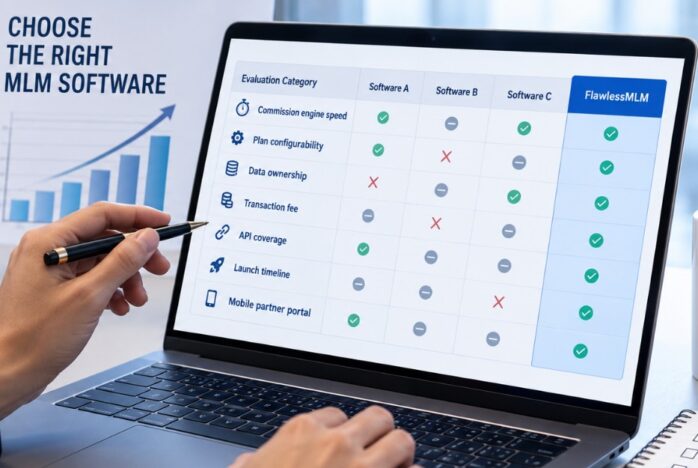
I compiled this table from our internal vendor analysis across 12 MLM software categories. We weight each category by its impact on operational cost over 24 months, not by feature count.
Evaluation Category
What to Measure
Weight (Impact on 24-Month Cost)
FlawlessMLM Benchmark
Commission engine speed
Period close time at 100K+ active partners
25%
Under 90 seconds for 500K+ partners
Plan configurability
Changes via admin panel vs. developer hours
20%
All plan changes via admin, zero code
Data ownership
Client owns domain, server, partner data
15%
Full ownership, only source code protected
Transaction fee
Percentage of commissions processed
15%
0.5% (market average: 1.5% to 2%)
API coverage
Payment, CRM, e-commerce, ERP connectors
10%
Public REST API, 20+ pre-built integrations
Launch timeline
Days from contract to live MVP
10%
7 to 14 days (white-label MVP)
Mobile partner portal
Native app or responsive web portal
5%
Native iOS/Android apps + responsive web
The two highest-weighted categories, commission engine speed and plan configurability, account for 45% of total impact. A slow engine generates support tickets when distributors see stale payout numbers. A rigid plan structure means every compensation adjustment requires a developer, which adds $2,000 to $10,000 per change order at most vendors.
Transaction fees matter more than most buyers realize at purchase time. At 0.5%, FlawlessMLM processes $500,000 in monthly commissions for $2,500. At 2%, the same volume costs $10,000 per month. Over 24 months, that $180,000 difference funds an entire custom platform build.
Request an MLM software demo to see these benchmarks in a live environment with your data.
Binary, Unilevel, or Matrix: Which Plan Structure Fits Your Product
Source: dinmo.com
The plan type is an engineering constraint, not a preference. I have watched companies lose 6 to 12 months of growth by picking the wrong structure and then spending another quarter migrating. The selection depends on three variables: product reorder cycle, target market recruiting behavior, and margin structure.
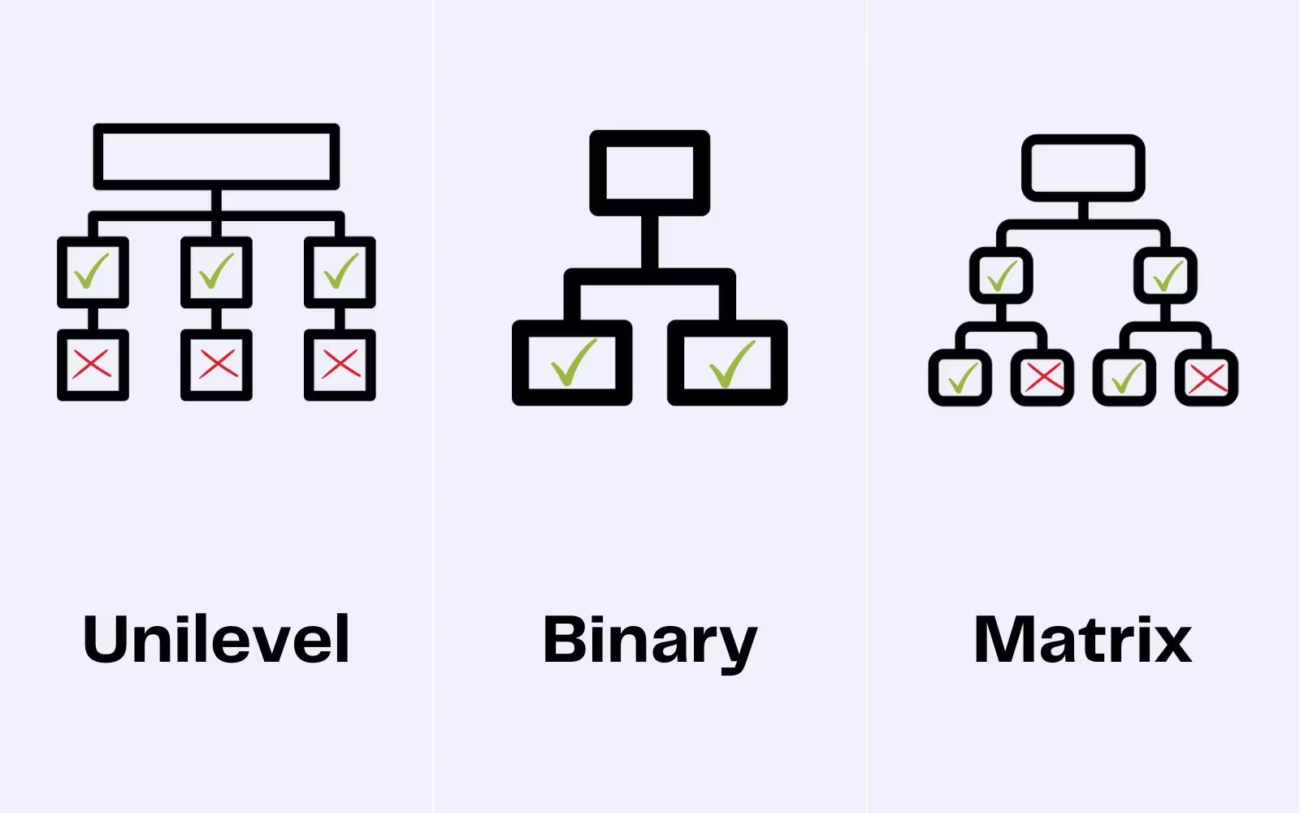
Binary MLM software splits every position into two legs. Volume-matching bonuses reward balanced growth. This structure works best with consumable products that have a natural 30-day reorder cycle. Health supplements, skincare, and nutritional products fit binary plans because the monthly purchase sustains commission flow. The engine complexity is high: volume matching, carry-forward, and leg balancing all require precise calculation. A rounding error of $0.01 across 100,000 partners creates a $1,000 discrepancy per period.
Unilevel MLM software pays a fixed percentage on each level, typically 5 to 10 levels deep, with no width restriction. Support overhead is low because there are no legs to balance and no spillover rules to explain. Broad product lines and service-based businesses fit this model. Compression logic skips inactive levels to maintain payout ratios for active leaders.
Matrix MLM software locks the tree to a fixed width and depth. Spillover fills positions below when a recruiter exceeds the matrix width. This creates a cooperative dynamic but demands a deterministic position-fill algorithm. Non-deterministic placement erodes trust because identical actions produce different tree positions depending on server timing.
Case Study: Global Trend, Binary Plan at Scale
Global Trend launched on FlawlessMLM’s platform with a binary compensation plan in 2017. The initial network had 50,000 registered partners. Over seven years, the network grew to over 2 million registered users across multiple countries. During that growth, the compensation plan went through four major revisions. Each revision shipped through FlawlessMLM’s admin panel configuration, with zero developer involvement. The commission engine processes Global Trend’s full binary period close in under 90 seconds, even at current scale. The platform operates on dedicated infrastructure with 99.9% uptime SLA.
What this case proves: a binary plan at million-plus scale requires an engine built for binary from the ground up. A generic commission calculator patched to handle binary breaks under volume-matching load at roughly the 50,000-partner threshold, based on our engineering benchmarks across 62 binary plan deployments.
Sell durable goods through a binary structure, and the tree stalls after the initial purchase wave. There is no natural reorder to sustain monthly volume. The plan type and the product type must match. In my experience, getting this wrong is more expensive than any other platform decision.
Affiliate Program Software and MLM: Where the Two Categories Merge
Source: azonpress.com
A growing number of companies operate hybrid models. The core business runs an MLM compensation plan for the distributor network. A parallel affiliate channel drives customer acquisition through bloggers, influencers, and content creators. Running these as two separate systems creates a data fragmentation problem.
MLM software affiliate program modules eliminate that fragmentation. Both partner types share one commission engine, one partner portal, and one reporting database. The affiliate management platform applies different payout rules per channel without duplicating infrastructure.
SaaS affiliate software handles recurring commissions for subscription products on a single tier. Affiliate tracking software attributes conversions across devices and sessions. Partner management software manages onboarding, approvals, and tier assignments. A multi-level affiliate program adds genealogy logic on top of all three. Standard referral software breaks at this point because it lacks the tree-calculation layer that network marketing MLM software provides.
In our project records, companies that run both affiliate and MLM channels from a single FlawlessMLM instance report 40% less time spent on payout reconciliation per commission period compared to clients who merged from two separate systems. That figure comes from timing data across 14 dual-channel deployments measured over Q4 2025 and Q1 2026.
Partner portal software quality drives engagement directly. Over 70% of distributor logins in our analytics come from mobile devices. A partner management system without responsive design or a native app loses daily active users within the first month. The commission tracking software inside the portal must display real-time PV, GV, and rank data, not batch numbers from the previous night. Stale data generates support tickets. Real-time data keeps distributors selling.
MLM Software Price: What Founders Actually Pay in 2026
MLM software price starts at $5,000 for a basic white-label instance on shared infrastructure. The ceiling for a custom enterprise platform with dedicated servers, native mobile apps, multi-language support, and custom compliance modules exceeds $150,000.
The mid-market sits between $15,000 and $40,000 for initial development. Monthly operational costs range from $500 to $3,000 depending on active partner count and processing volume. These numbers come from our pricing records across 400+ projects at FlawlessMLM.
What inflates cost is not feature count. Three factors drive the price above mid-market: hybrid commission logic (a plan combining binary legs with unilevel overrides requires custom engineering), third-party integrations (ERP, payment gateway, and e-commerce platform connectors each add development scope), and regulatory compliance (income disclosure reporting, FTC-compliant earnings representations, GDPR and CCPA data controls).
FlawlessMLM charges a 0.5% transaction fee on commissions processed. For a network paying $500,000 per month in commissions, that is $2,500. At the market-average rate of 1.5% to 2%, the same volume costs $7,500 to $10,000. The annual savings of $60,000 to $90,000 often exceeds the initial platform investment.
AI Inside the Commission Engine: Substance vs. Marketing Copy
Nearly every MLM vendor mentions AI in 2026. The substance behind those claims varies. We tested three AI applications that produce measurable ROI inside FlawlessMLM’s commission engine.
Predictive churn scoring flags partners whose engagement index drops below 40 based on login frequency, order recency, and GV trend. On a Tuesday morning when the weekly digest arrives, a team leader in Kuala Lumpur sees three flagged partners in her second-level downline. She contacts each before end of day. Two of three place an order that week. Without the scoring layer, that intervention does not happen until the next period close reveals the dropout.
Fraud detection identifies suspicious enrollment clusters and self-purchasing patterns in real time. Across three enterprise deployments measured over Q1-Q2 2026, companies using this module reported 15% to 25% fewer fraudulent payouts per period.
AI-assisted plan modeling simulates the financial impact of a bonus threshold change across the existing genealogy tree. A two-week manual modeling exercise becomes a 30-minute automated projection. This capability matters most at the scaling inflection point, when a compensation plan that worked for 5,000 partners needs adjustment for 50,000.
See these benchmarks live.
Our team runs a free 30-minute demo with your compensation plan structure loaded into a test environment. No obligation, no sales pitch, just performance data.
Request a Demo Discuss Your Project
FAQ: MLM Software & Affiliate Program Software
What is the best MLM software for a startup in 2026?
The best MLM software for a startup combines a configurable commission engine with a fast launch timeline. FlawlessMLM delivers a white-label MVP in 1 to 2 weeks, which lets founders test the compensation plan with real distributors before committing to a full custom build. The platform supports binary, unilevel, and matrix plans from the same codebase.
How do I compare MLM software platforms objectively?
Compare on five metrics: commission engine processing time at 50,000+ partners, plan change method (configuration vs. code), data ownership terms, API availability, and vendor case studies matching your plan type. Feature lists are a weak signal because they hide production-level performance gaps.
Can MLM software handle both affiliate and network marketing programs?
Yes. MLM multi level marketing software includes affiliate tracking as a built-in module. FlawlessMLM runs both multi-tier affiliate programs and full MLM compensation plans inside one platform. Affiliate partners and MLM distributors share the same partner portal and commission engine.
What does MLM software cost on average?
MLM software price starts at $5,000 for a white-label instance. Mid-market companies spend $15,000 to $40,000 on initial development, with $500 to $3,000 per month in ongoing fees. FlawlessMLM’s 0.5% transaction fee saves $60,000 to $90,000 annually compared to the market-average 1.5% to 2%.
Is binary or unilevel better for health and wellness MLM?
Binary works better when the product has a natural monthly reorder cycle, which most health and wellness consumables do. The two-leg structure keeps recruitment simple. Unilevel fits broad product lines where frontline width matters more than tree depth. FlawlessMLM consultants model both against your margin before launch.
What is the difference between referral software and multi-level affiliate software?
Referral software tracks one tier: one referral, one commission. Multi-level affiliate software calculates payouts across two or more tiers with genealogy logic and per-level qualification rules. Standard referral tools break at the second level because they lack the tree-calculation engine.
How fast can FlawlessMLM launch an MLM platform?
A white-label MVP launches in 1 to 2 weeks. A fully custom platform with branded apps and unique compensation logic takes 8 to 16 weeks. We have launched 400+ projects since 2004 across 90+ countries.
You hold it in your hand. It runs nonstop, handling millions of bets around the clock. So, what’s really going on behind the scenes of your online casino app, and why does the technology keep getting better?
Online casino apps are quietly some of the toughest pieces of consumer software around.
Here is what they’re actually doing: Streaming high-def video, processing real-money bets in just milliseconds, running random number generators checked for fairness and keeping all this going at the same time for maybe thousands of users.
And it all happens right on your phone, over mobile networks, with live roulette spins that don’t miss a single frame.
That’s not easy. The fact that it all works smoothly most of the time says a lot about how much the tech has changed.
The global online casino industry was worth $19.11 billion in 2024 and is on track to almost double to $38 billion by 2030, growing at a pace of 12.2% a year, according to Grand View Research. That surge is fueled by technology more than anything else.
Mobile-first is why your phone is now the casino floor
Source: androidcure.com
The move to mobile didn’t just happen on its own. Developers had to completely rethink casino games for smaller screens, dicey network connections and a wild mix of Android devices.
Mobile and tablet platforms pulled in 57.14% of all online gambling revenue in 2025 and will grow the fastest through 2031, according to Mordor Intelligence.
That kind of dominance pushes casino operators to treat mobile performance as a way to win, not just something to check off the list.
The duty of care built into the code
Casino tech isn’t just about fun, it’s about safety, too. Regulators and operators treat responsible gambling tools as core features, not just nice extras.
Look at Betway: Once you go through the Betway app download, you’ll find deposit limits, self-exclusion and direct connections to outside support groups. These tools aren’t just tacked on, they’re baked right into the app’s account features.
5G changes the game
For a while, mobile casino performance just couldn’t get past what 4G could offer. Live dealer streams sometimes buffered, loading times got sketchy when things were busy and multiplayer games felt a bit slow. Then 5G rolled in and started changing the game.
With speeds up to 10 gigabits per second, about a hundred times faster than 4G, 5G lets mobile casino apps load pretty much instantly.
Picking a game and making a bet is so much quicker. But the real win is lower latency. 5G can slash lag down to under 10 milliseconds.
That means smoother, real-time play and complex graphics loading with little to no wait.
Live dealer tech
Source: mobilevillage
Live dealer games are hands down the most ambitious tech bit in online casino apps. It’s not just video streaming; it’s synchronized, low-latency and multi-camera broadcasting, fused with live betting software and unpredictable game results.
These setups happen in giant warehouses turned into classy casino floors, staffed 24/7 with professional dealers.
Slick camera rigs cover each game from different angles, while custom-built software feeds it all to your device almost instantly.
Security runs on the engineering you never see
Every login, payment and game outcome in a casino app is protected by layers of security. Top apps use SSL encryption for data and payments, with two-factor authentication and biometrics, such as fingerprint and facial recognition, stacked on top.
The risks of slipping up are huge. Each data breach costs about $4.45 million, which is a 15% jump from the last few years according to Box Piper.
For online casinos dealing with sensitive info and big money, the damage can reach far beyond the immediate financial loss.
Cloud infrastructure made scaling possible
Source: journal.com.ph
You don’t see it, but cloud infrastructure is a huge part of casino technology. During massive events, such as the Super Bowl or Champions League final, betting activity can skyrocket in minutes.
Cloud platforms like AWS, Google Cloud and Microsoft Azure scale up and down to handle these spikes, so the apps keep running smoothly without crashing or bogging down. Top cloud services bring extra security too, with DDoS protection, strong firewalls and encrypted storage.
What’s driving the next wave
With faster networks, powerful mobile chips and ever-better streaming tech, online casino apps are moving into territory that seemed impossible a few years back.
Multi-camera studios, near-zero lag and biometrics, these features are standard or soon will be.
The U.S. market alone hit $6.78 billion in 2024 and is likely to grow 11.7% a year through 2030, with things like better internet and 5G driving that growth according to Grand View Research.
From a tech standpoint, the pace never slows. Developers target networks that aren’t even fully rolled out yet, optimize for devices we haven’t seen and build features for regulations still being drafted.
Running a business on hunches worked fifty years ago. Today? Companies can’t wing it anymore. Competition sprints ahead while you’re still thinking. Customers want everything perfect, right now. One bad guess costs thousands. But here’s what’s changed: technology handed businesses X-ray vision into their own operations, turning mysteries into facts.
The Cost of Operating Blind
Companies flying blind crash into problems constantly. Factory managers guess machine maintenance needs, leading to breakdowns during busy periods. Managers’ inventory estimations result in either insufficient stock or excess inventory. Power firms gamble on demand, which leads to brownouts or energy waste.
Add up these misses and you’re looking at serious cash down the drain. Dead equipment kills production. Wrong inventory means angry customers walking out empty-handed or money frozen in products gathering dust. Bad energy planning hits everyone’s wallet.
Human brains just can’t juggle what modern business throws at them. One factory floor has hundreds of machines. Each machine has dozens of parts wearing out on different schedules. Retail chains? Thousands of products spread out over stores, warehouses, and distribution centers. Electric grids manage a city’s power demands against its supply. Maintaining that requires considerable help.
Source: investopedia.com
Data Replaces Assumptions
Sensors and connected gadgets now watch everything, all the time. Machines tattle on themselves constantly. Every product gets tracked from warehouse to checkout. Assembly lines count output by the millisecond. Facts pour in nonstop, making guesses obsolete.
Hard numbers expose what instincts miss. That motor isn’t just “running funny.” Temperature readings show it’s climbing three degrees weekly, heading for failure next Thursday. Wednesday afternoons don’t just “seem quiet.” Transaction logs prove customer traffic nosedives after 2 PM, so why schedule five cashiers?
This crystal ball effect reaches everywhere. Delivery drivers follow routes built on real traffic data, not some software’s best guess. Factories make what customers actually buy today, not what someone predicted six months ago. Bad products get yanked instantly, not after complaints pile up.
What Teams Should Measure First
The trick is not measuring everything just because the technology exists. That creates digital clutter. Smart companies start with the questions that cost them money, time, or trust. Then they connect the right data to those questions.
A practical starting point usually includes:
Equipment health, especially temperature, vibration, pressure, and energy use
Inventory movement, including slow sellers, shortages, and sudden demand spikes
Customer behavior, such as peak buying hours and repeated complaints
Delivery performance, including delays, route changes, and missed handoffs
Energy consumption, especially unusual spikes during normal operations
This keeps the system useful instead of overwhelming. Nobody needs another dashboard full of pretty charts that nobody checks. The goal is simple: show people where attention is needed right now. Good data should feel like a clear instruction, not homework.
Source: nxfounder.com
Building Intelligence Networks
Operations today need equipment that talks to other equipment, sharing updates instantly. Blues IoT creates smart grid connectivity that weaves machines, sensors, and controls into one big conversation. This allows companies to watch everything remotely, spot trends, and fix problems without anyone touching a button.
These brain networks transform number soup into clear action plans. Computers catch weird patterns while humans are eating lunch. Math models predict next month based on last year. Systems adjust themselves faster than any person could react. The surprising part is that everything becomes sharper over time. Each day feeds the beast more data. Decisions teach lessons. Predictions get scary accurate as patterns emerge from the noise.
Small Signals Beat Big Surprises
The scary thing about operational failure is that it rarely arrives out of nowhere. Most problems whisper before they scream. A pump vibrates a little more than usual. A freezer door opens too often during one shift. A delivery route starts running ten minutes late every Friday.
Those small signals are easy to miss when people rely on memory, instinct, or end-of-day reports. Sensors and predictive maintenance systems help teams spot early warning signs through things like vibration, temperature, pressure, and energy-use data.
Common warning signs include:
A machine running hotter than usual
Vibration slowly increasing week after week
Energy use jumping without a clear reason
Repeated delays at the same warehouse step
Stock moving faster or slower than expected
Data catches those whispers before they become expensive problems. Instead of waiting for a machine to die, teams see the pattern forming early. Instead of blaming a busy season for late deliveries, managers can spot the exact warehouse step slowing everything down.
The key benefit is simple:
A five-minute adjustment beats a five-day shutdown
A quick staffing change beats a customer service mess
An early maintenance alert beats emergency repair costs
A small inventory correction beats empty shelves
Modern operations are not just about reacting faster. They are about noticing sooner.
Source: moneynavigator.io
The Competitive Edge
Businesses dumping guesswork pull ahead fast. Less waste, because they know exactly what’s needed when. Customers stay happy because stores stock what they want before they know they want it.
Bills shrink as everything runs like clockwork. Speed kills the competition too. While rivals hold meetings to debate maybes, data-driven companies already moved.
Opportunities pop up on dashboards immediately. Fixes happen before problems blow up. Market shifts trigger instant pivots, not committee reports. Small players compete with giants when everyone sees the same clear picture. Local shops optimize just like massive chains. Family businesses make decisions as sharp as corporations with entire analytics departments.
Conclusion
Guessing belongs in museums with typewriters and rotary phones. Today’s tools show businesses exactly what’s happening, when, where, and why. Companies grabbing this clarity zoom past those still squinting through fog. The hardware exists. Sensors cost pocket change. Networks blanket the country. Software makes sense of chaos. Only one question matters: how fast will businesses drop their blindfolds and see what’s really going on?
FAQs
1. What does guesswork look like in modern operations?
Guesswork usually looks harmless at first. It is a manager ordering stock based on “what usually sells,” a maintenance team waiting until a machine sounds bad, or a delivery planner trusting old route patterns. The problem is that modern operations move too fast for loose assumptions. Small mistakes spread quickly across inventory, staffing, production, and customer service.
2. Why is data better than experience alone?
Experience still matters, but it works best when it has facts to stand on. A seasoned manager may know when something feels off, but data shows where, when, and how often it happens. That turns a gut feeling into a decision. Data quality matters because strong decisions depend on information that is accurate, complete, consistent, timely, valid, and unique.
3. How do sensors help businesses avoid expensive problems?
Sensors keep watch when people cannot. They can track vibration, temperature, current, pressure, movement, and other signals that show whether equipment or processes are behaving normally. Predictive maintenance uses this kind of data to spot possible equipment issues before they interrupt operations. That means fewer surprise shutdowns, faster fixes, and less money lost to problems that could have been caught earlier.
AI-enhanced applications are supposed to make life easier for humans, right? Unfortunately, software developers and engineers can combine the best LLMs with forward-thinking algorithms and still produce a product that falls flat. And when it happens, the problems can often be traced back to the user interface (UX).
GojiLabs, a leading provider of AI UX design services, says that machine learning and AI engineering have evolved at a pace that has left user interaction behind. In other words, the frameworks guiding how people interact with AI systems have not kept up with the pace of machine learning and LLM development. This is a problem in desperate need of a solution.
Traditional Rules Don’t Apply
Traditional UX design relies on a fixed set of rules. For example, a user clicks a button, and a predictable event occurs. Intelligent applications break the rules by serving up variable and dynamic outputs. Here is the challenge: bridging the gap between computational complexity and human interaction. It requires a new way of thinking.
AI UX Design Services bridge the gap with specialized front-end strategies intentionally designed for humans. In the hands of a skilled developer, an AI interface becomes a tool that interacts seamlessly between the user and the underlying workflow. It’s seamless to the user, but highly complex for the technology stack.
Source: makeuseof.com
Embrace the Ambiguity
Software engineers may struggle with AI UX design because they do not like unpredictability. They are used to a system behaving according to traditional rules. On the other hand, a system capable of generating unique content or interpreting open-ended prompts must actively shape and respond to the end user’s experience in real time. This creates quite a bit of ambiguity in the development pipeline.
Ambiguity leads to confusion and alienation. Developers are left to guess what a platform can actually do. As a result, adoption rates remain low. What is the solution? Intuitive design guardrails that turn technical capabilities into more predictable digital environments. With guardrails in place, engineers can more easily embrace the ambiguity.
Make the Invisible Workflow Visible
Many AI systems fail because the user cannot see enough of the process. They enter a prompt, wait for a result, and receive an answer without any useful sense of how the system got there. That might be acceptable for low-stakes tasks, but it becomes a problem when the output affects work, money, customers, safety, or decisions.
A stronger AI interface gives users small signals that explain the workflow without slowing them down. These signals can include:
A short note showing what the system is analyzing
A confidence indicator when the output depends on uncertain information
A source preview when the answer is based on retrieved content
A review step before the system takes action
A simple way to correct the AI when it misunderstands intent
The point is not to expose every technical layer. Most users do not need that. What they need is enough visibility to understand whether the system is helping them, guessing, asking for confirmation, or waiting for their input.
Source: uxplanet.org
5 Pillars of the Smart Experience Architecture
The software engineer’s goal for UX design is high adoption rates. He wants end users not only to use his system but also to be happy doing so. With that in mind, development rests on five core pillars:
Interaction blueprinting – Engineers must construct conversational frameworks so that software understands intent without adding friction to the experience.
Conversational styling – Likewise, conversational styling creates a voice, structure, and pacing that make users feel comfortable. Users must feel as if they are interacting with humans.
Human-in-the-loop – Human users must be kept in a loop whenever possible. Why? Because total automation introduces unnecessary operational risks.
Failure anticipation – Engineers must develop with the understanding that things fail. They must anticipate failure and build in mitigation responses so that UIs continue to function as expected.
Adaptive layouts – Because AI software is dynamic, layouts need to be as well. Static layouts are no longer sufficient for AI UX designs.
An exceptional AI UX design isn’t completed at deployment. Rather, software developers and engineers continue to refine the experience so that it stays at the cutting edge. Of course, the system must also maintain accuracy and reliability throughout its life cycle.
Feedback Loops Keep the Product Honest
AI products improve when the interface makes feedback easy. This does not mean forcing users to fill out long forms or rate every answer. It means creating natural moments where users can correct the system, clarify their intent, or signal that an output was not useful.
A simple “try again” button is helpful, but it is not enough. Stronger feedback tools ask why the answer missed the mark. Was it too vague? Too long? Based on the wrong assumption? Missing context? Once that information is collected, the product team can identify patterns that would otherwise remain hidden.
Feedback also gives users a sense of participation. They are not just receiving outputs from the system. They are shaping the interaction. That matters because AI interfaces often improve through repeated use. The more clearly users can communicate what worked and what failed, the more valuable the product becomes over time.
Source: kindo.ai
Business Teams Need to Understand the Interface Too
AI UX is not only a design or engineering issue. Business teams also need to understand how the interface shapes adoption. A company can invest heavily in AI infrastructure and still see weak results if employees or customers do not understand how to use the product confidently.
Executives often focus on what the AI can automate. That is understandable. Automation promises speed, scale, and lower operational friction. But the user is still the person deciding whether the software feels useful enough to keep using. If the interface creates uncertainty, even the most advanced system can feel unfinished.
This is why AI UX design should be part of product strategy from the beginning. Business leaders, designers, engineers, and domain experts should agree on where automation belongs, where human approval is required, and what level of explanation users need. Those decisions directly affect trust.
At the End
As the digital world evolves, comprehensive AI UX design services will become the norm. They are in their infancy right now, but service providers already on the ground floor have a built-in advantage over those that will follow later.
From the business executive’s perspective, now is the time to start investing in the AI UX design that will drive modern applications forward. AI will continue to get faster, more capable, and more deeply embedded in daily workflows. But the success of those systems will still depend on something very human: whether people understand them, trust them, and feel comfortable using them.
Munich is one of those cities where renting a car can feel like extra homework. Parking is not fun, old streets can be tight, and the best parts of the city are already linked by trains, trams, buses, or easy walks.
For most visitors, Munich public transport is cheaper, calmer, and more practical than driving. Once you understand the basics, the system feels surprisingly friendly.
You do not need to memorize every line. You only need to know which ticket fits your day, where the airport sits, and how to move without second-guessing every stop.
How Munich Public Transport Works In Simple Terms
Source: tripadvisor.com
Munich uses one joined-up fare system, so tourists can move between U-Bahn, S-Bahn, tram, bus, and some regional trains without buying separate brand-specific tickets.
The most important word is “zone.” Zone M covers Munich city and nearby areas, while zones 1 to 12 cover the wider region. Munich Airport is in Zone 5, which is why a city-only ticket is not enough for the airport ride.
Here is the easy tourist version:
U-Bahn is best for fast city movement
S-Bahn is best for the airport and suburbs
Trams are good for relaxed sightseeing
Buses fill the gaps between rail lines
If your ticket covers every zone on your route, you are basically doing it right.
The Best First Move After Landing At Munich Airport
From Munich Airport, the simplest route into the city is usually the S-Bahn. Lines S1 and S8 both connect the airport with central Munich, and Munich Airport says the journey to the central train station takes about 40 minutes.
Because the two lines alternate, there is usually a 10-minute interval between the airport and the city center.
If you will travel again after checking in, look at the Airport-City-Day-Ticket. It covers travel between the airport and Munich city area in zones M-5, works across S-Bahn, U-Bahn, bus, tram, and regional trains, and stays valid until 6 a.m. the next day. That is perfect for landing, hotel check-in, dinner, and one more ride back.
Choosing The Right Ticket Without Overthinking It
The ticket menu looks more complicated than it really is. Start with your actual plan for the day. If you are taking one simple ride, a single ticket can work. If you expect several rides, a day ticket is usually easier. Munich’s official tourism site says the day pass is worthwhile for more than two journeys within a zone area.
Situation
Best ticket idea
Why it helps
One city ride
Single ticket
Simple and direct
Several city rides
Zone M day ticket
No repeat buying
Airport plus city
Airport-City-Day-Ticket
Covers M-5
Two to five people
Group day ticket
Usually better value
And for your evening plans, if your trip includes restaurants, events, business dinners, or private escort München services, choose accommodation near a reliable U-Bahn or S-Bahn stop. It makes the whole night smoother without depending on taxis.
Where To Buy Tickets And Which App To Use
Source: mvg.de
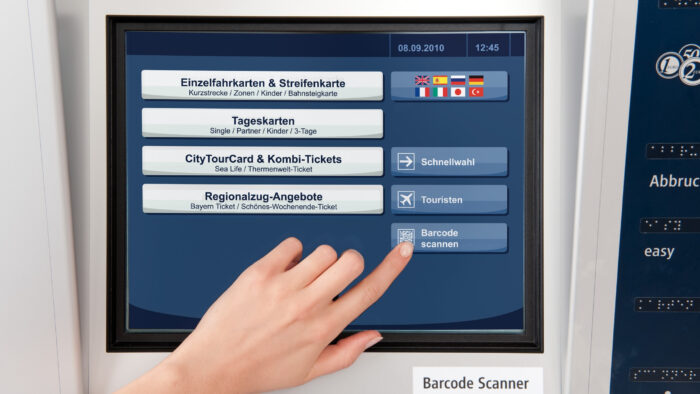
You can buy Munich public transport tickets from station machines, many bus and tram machines, online shops, or the MVGO app. MVG says station machines are available at U-Bahn and S-Bahn stations and support English, German, and other languages. Since January 2026, MVGO also allows registration-free purchases for single tickets, day tickets, and weekly tickets.
The app is useful because it combines tickets, routes, and live departures in one place. Still, machines are fine if your phone battery is low or you prefer paying by card or cash.
Watch validation, especially when buying from older machines. Many digital tickets are already valid, but some paper tickets must be stamped before boarding.
Moving Around The City Like A Local
The U-Bahn is the easiest way to move quickly between central districts. Use it for Marienplatz, Odeonsplatz, Sendlinger Tor, Schwabing, the Olympic area, and many museum-heavy days.
The S-Bahn is better when you cross the whole city, head to the airport, or leave the center. Trams are slower but more enjoyable when you want to see streets, squares, and neighborhoods above ground.
Munich’s tourism office describes U-Bahn and S-Bahn as the heart of the network, while buses and trams help with less central areas and sightseeing. That is a good way to think about your own route.
A few habits help:
Check direction by final station
Let people exit before boarding
Keep luggage away from doors
Where To Stay If You Will Not Rent A Car
A hotel near an U-Bahn or S-Bahn station is more useful than a prettier hotel far from transport, especially on short visits with early starts too. You do not have to stay directly on Marienplatz.
Hauptbahnhof is convenient for airport trains and day trips, although the area is busy. Maxvorstadt, Lehel, Haidhausen, Glockenbachviertel, and Schwabing can all work well if you choose a station-friendly address.
This matters most when your plans stretch into the evening. A central or well-connected base lets you enjoy dinner, nightlife, or a late walk without turning every return trip into a taxi decision. In Munich, the best transport choice often starts with where you sleep.
What Tourists Should Know About Zones
Source: citytourcard-muenchen.com
Zones are the part of Munich public transport most likely to confuse first-time visitors. For normal sightseeing, you will mostly stay inside Zone M. For the airport, you need M-5. For lakes, suburbs, conference parks, or day trips outside the center, check the route in MVGO or MVV before buying.
Important fact: Munich Airport is in Zone 5, not Zone M.
That single detail prevents the most common ticket mistake. A regular city ticket feels logical because the airport belongs to your Munich trip, but fare rules do not work that way.
The ticket must match the zones printed for your route. When you are unsure, search the exact start and end stations in the app.
When Public Transport Beats A Taxi
Taxis are helpful with heavy luggage, very late arrivals, rainy nights, tight schedules, or door-to-door business needs.
But for normal sightseeing, public transport usually wins. Trains avoid traffic, central stations sit close to major sights, and day tickets remove the need to keep paying for each movement.
The airport connection is also strong because both S1 and S8 serve central Munich.
Public transport works especially well for:
First-time sightseeing
Museum and restaurant hopping
Airport transfers with light luggage
Meetings near central stations
Day trips by regional train
A rental car only starts making sense for rural stops or places not well linked by rail. For Munich itself, skip the keys.
Munich public transport is easy once you stop treating it like a puzzle. For city-only days, think Zone M. For the airport, think M-5. For several rides, think day ticket. For live help, use MVGO or MVV instead of decoding a wall map while people rush past you.
Before your first ride, remember this:
Check zones before paying
Validate paper tickets when required
Keep your phone charged
Use S-Bahn for the airport
That is the whole game. Munich is built for visitors who do not want a rental car, and after your first clean ride into the city, you will probably be glad you skipped the keys.
Stacking rings has become a major part of modern bridal styling, but creating a stack that feels balanced takes more than simply adding multiple bands together. The most refined stacks are intentional. They combine different shapes, widths, and textures while still leaving enough visual space for each ring to stand out individually.
Here’s how to style wedding bands in a way that feels balanced, wearable, and modern. For those exploring stackable bridal jewelry, With Clarity offers a range of wedding bands made to pair naturally with engagement rings while maintaining comfort, balance, and long-term versatility.
1. Start with One Main Focal Ring
Every bridal stack needs a visual anchor. In most cases, this is either the engagement ring or the boldest band within the stack.
Once the focal ring is established, the surrounding bands should support it rather than compete with it. Slimmer bands usually work best alongside larger center stones or more detailed designs because they help create balance instead of visual heaviness.
This is why many diamond wedding bands for women are now designed with slimmer profiles that layer naturally alongside engagement rings.
2. Think About the Order Before Adding More Bands
The order of the rings can change the entire feeling of the stack. Some people prefer the wedding band closest to the hand, followed by the engagement ring and then an anniversary band. Others like to frame the engagement ring with two similar bands so the center stone feels more balanced.
There is no single rule that works for every ring shape, but the stack should look intentional from top to bottom. A good way to test this is to place the rings in different orders before committing to one arrangement. Pay attention to how the stones line up, where the metal touches, and whether the stack looks too top-heavy.
A few useful order ideas include:
A plain band below the engagement ring for a clean base
A diamond band above the engagement ring for extra brightness
Matching slim bands on both sides for symmetry
A curved band placed closest to the center stone for a better fit
3. Mix Different Widths and Textures
Stacks where every ring has the exact same thickness or surface detail can quickly feel flat and boring.
A more balanced approach is mixing rings with different textures to create visual intrigue:
A pavé band with a plain polished ring
A twisted band beside a clean metal band
A slim eternity band next to a slightly wider solitaire setting
The variation creates separation between the rings, allowing each one to remain visible rather than blending into one heavy stack.
Source: unsplash.com
4. Balance Sparkle With Plain Metal
Diamond bands add beauty, but too much sparkle in one stack can make the overall look feel busy. Plain metal bands are useful because they give the eye a place to rest. They also make diamond details stand out more clearly instead of forcing every ring to compete for attention.
A polished gold, platinum, or white gold band can soften the look of multiple pavé or eternity bands. It also makes the stack feel more wearable for everyday settings, especially if the engagement ring already has a large center stone or halo detail.
The key is contrast. If one ring is highly detailed, the next one can be simpler. If one band has strong texture, another can be smooth. This creates a stack that still feels bridal and special without becoming visually overwhelming.
5. Use Thin Spacer Bands for Better Separation
When multiple diamond bands sit directly against one another, the stack can start to feel visually crowded. In some cases, the settings may also rub against each other over time.
A thin spacer band placed between larger rings creates a cleaner transition and introduces negative space into the stack. Even a very slim, plain metal band can make the entire arrangement feel more intentional and easier to distinguish visually. This technique works especially well between engagement rings and larger eternity rings.
6. Choose Bands That Follow the Shape of Your Ring
Not every engagement ring pairs naturally with a straight wedding band. Lower-set rings or elongated center stones often leave gaps when stacked with standard bands.
Contoured, curved, or open bands are designed specifically to follow the outline of the engagement ring more closely. This creates a cleaner fit and helps the stack feel cohesive rather than layered randomly.
Many modern wedding bands now incorporate subtle curves or chevron shapes to create a more integrated appearance.
7. Match the Stack to the Engagement Ring Setting
The setting of the engagement ring should guide the entire stack. A high-set solitaire usually gives more room for straight bands to sit neatly underneath it. A low-set ring may need a curved or open band so the pieces do not push awkwardly against each other.
Elongated shapes, such as oval, emerald, pear, and marquise stones, often look beautiful with bands that create movement around the center stone. A chevron band can point toward the stone and make the stack feel more structured. A curved band can soften the outline and make the rings look like they were chosen together.
The setting height, prong placement, and stone shape all matter. Looking at the ring from the side is just as important as looking from above.
8. Mix Metals Carefully
Mixed-metal bridal stacks continue to grow in popularity, but balance matters.
Instead of combining several different tones equally, it usually works better to keep one dominant metal and introduce a second tone more subtly. For example, a mostly white gold stack may include one rose gold or yellow gold band to add contrast without making the combination feel disconnected.
This approach helps the stack feel layered while still maintaining visual consistency.
Source: unsplash.com
9. Don’t Overload Every Finger
One of the easiest ways to make a bridal stack feel overdone is by adding too many rings across the entire hand.
If the ring finger already features multiple bands, it often looks cleaner to keep the surrounding fingers more minimal. A single delicate ring on the pinky or index finger usually creates better balance than stacking several additional rings nearby.
Leaving some visual space around the bridal stack allows the rings themselves to stand out more naturally.
10. Keep Long-Term Wearability in Mind
The best bridal stacks are not only visually balanced but also comfortable enough for everyday wear.
Before adding multiple bands, it helps to consider:
How the rings sit together
Whether they move comfortably
If the stack feels too heavy on the hand
How easily the bands pair with future anniversary rings
This is especially important for diamond wedding bands for women, which are often worn daily for years.
Final Thought
A well-styled bridal stack is about proportion, spacing, and balance rather than quantity. Mixing textures, varying band widths, and incorporating thoughtful spacing allows each wedding band to maintain its own identity while contributing to a cohesive overall look.
Crypto markets have always had a transparency problem.
When investors buy a stock, they can usually find company filings, ownership details, financial reports, and risk disclosures. But when they buy a token, the information is often scattered across websites, docs, social media posts, governance forums, and exchange announcements.
This creates confusion.
Who owns the token supply?
How many tokens belong to insiders?
Are there market maker agreements?
What are the listing terms?
Is there a buyback plan?
Who controls the project entity?
This is why crypto compliance is becoming more important.
In May 2026, more than 40 crypto firms, including Coinbase, Kraken, Binance.US, MEXC, Anchorage Digital, BitGo, Copper, GSR, FalconX, and others, joined the Transparency Alliance. The group supports Blockworks’ Token Transparency Framework, a disclosure standard designed to bring stock market-style transparency to token markets.
So, does this mean crypto is entering a fully compliant institutional era?
It gives token issuers a common way to share important market information. According to Binance.US, the framework covers topics such as token economics, insider allocations, entity structure, and market maker arrangements.
This matters because many token projects disclose information in different formats. Some provide detailed documentation. Others provide very little. For exchanges, institutions, and users, this makes due diligence harder.
The framework is trying to create a shared language.
It does not decide whether a token is a good investment. It does not automatically make a token safe. It simply helps market participants see more information before making decisions.
Why Transparency Has Been Difficult in Crypto
Unlike public companies, most token projects were never built around traditional disclosure practices. Many began as developer communities, decentralized networks, or startup teams focused on technology rather than investor reporting.
As a result, important information often ended up spread across multiple channels. A vesting schedule might appear in one document. Governance decisions might be posted in a forum. Treasury information could be discussed on social media. Market structure details might never be disclosed publicly at all.
Several factors contributed to this situation:
Global operations with no single reporting standard
Rapid token launches during bull markets
Different disclosure expectations across jurisdictions
Limited industry agreement on what information should be public
The Token Transparency Framework attempts to solve this fragmentation problem by creating a consistent disclosure structure that can be used across projects. Instead of forcing investors to search through dozens of sources, the goal is to make important information easier to locate and compare.
If an exchange lists a token with unclear supply, hidden insider allocations, or unknown market maker deals, users may face serious risk. This also creates legal and reputational risk for the exchange.
That is why Coinbase, Binance.US, Kraken, and other major firms are supporting stronger disclosure standards.
Binance.US said it joined the Transparency Alliance to support stronger disclosure standards and market integrity in token markets. Its CEO, Stephen Gregory, said the framework gives clear criteria to evaluate crypto assets.
For exchanges, this is not only about public image. It is also about preparing for a more institutional market.
Why Crypto Compliance Is Changing
Crypto compliance used to focus mainly on KYC, AML, sanctions screening, and exchange licenses.
Now it is expanding.
Compliance is also becoming about token transparency, market structure, investor protection, and disclosure quality. Institutions do not want to invest in markets where basic information is missing.
Blockworks said the framework includes two filing types: a one-time filing for early-stage or post-launch projects, and a continuously updated filing for mature protocols. These filings can include entity structure, insider allocations, exchange listing terms, market maker agreements, and buyback programs.
This is closer to how traditional markets think.
Not exactly the same as stocks, but moving in that direction.
What Institutional Investors Usually Look For
Source: investopedia.com
Institutional participation has become one of the biggest themes in crypto over the past several years. Large investors generally operate under stricter risk management standards than retail traders.
Before allocating capital, they often want answers to questions that many crypto projects historically did not disclose clearly.
Common areas of focus include:
Token distribution and vesting schedules
Governance and voting structures
Treasury management practices
Legal entity ownership
Liquidity arrangements
Market maker relationships
Revenue and value accrual mechanisms
Standardized disclosures make these areas easier to evaluate. They also help investors compare projects using a consistent framework rather than relying on fragmented information.
For many institutions, transparency does not eliminate risk. However, it can make risk easier to measure. That distinction may become increasingly important as larger pools of capital enter digital asset markets.
Does This Mean Full Compliance Has Arrived?
Not yet.
The Transparency Alliance is an important step, but it is still industry-led. It is not the same as a full legal disclosure regime created by regulators.
There are still many questions.
Will all exchanges require these filings?
Will investors actually read them?
Will projects update information honestly?
Will regulators accept this model?
Will weak projects avoid disclosure?
These questions matter.
A disclosure framework only works if the market values it. If top exchanges, funds, and custodians start treating disclosure as a basic requirement, then projects may have to follow.
Final Thoughts
The Token Transparency Framework shows that crypto is becoming more serious about market standards.
For years, many token buyers had to make decisions with incomplete information. That may not work in the next phase of the industry.
As more institutions enter crypto, they will ask for clearer disclosures, better controls, and stronger market integrity.
Coinbase, Binance.US, Kraken, and other firms joining the Transparency Alliance does not mean crypto has solved its compliance problem. But it does show where the industry is heading.
The next era of crypto may not only be about faster chains or higher yields.
It may be about trust, disclosure, and transparency.
As mobility issues develop with age or with health issues, the ability to live independently at home is becoming increasingly important. For many people, going up stairs might be a problem to do, unpleasant or perhaps unsafe.
A stair lift is a practical device, which can enable people to navigate their home freely and comfortably and with more confidence.
Professional stairlifts Teesside services offer custom solutions that meet the needs of homeowners seeking mobility options without relocation or extensive renovations.
Stairlifts have been improved by the modern designs and advanced safety features, thus making them effective devices for independent living.
Why Stairlifts Are Becoming More Popular
Source: velocityhomelifts.com.au
Mobility solutions are no longer considered ‘bonus features. Many families today who have aged or face mobility limitations see them as needed home improvements.
Homeowners are increasingly seeking affordable stairlift installation because stairlifts not only minimize the risk of falls but also provide long-term convenience and peace of mind.
Supporting Independent Living
A very positive aspect of owning a stair lift is their ability to keep you independent in your own home. Users are able to remain in their living space without using stairs to get up and down or transferring to a one-level house.
Reducing the Risk of Injury
One particular worry is falling down stairs, particularly for older residents. Stairlifts reduce physical stress and make homes a safer place to live.
Types of Stairlifts Available
Today’s stairlift systems are designed to fit various property layouts and users.
Straight Stairlifts – Straight stair lifts are ideal in a staircase of a simple nature that is not curved or has any landing points. These tend to be faster to install and are less expensive.
Curved Stairlifts – Curved stairlifts are designed for stairs, those with bends, corners and/or various landings. They are made especially to fit the shape of the stairs accurately.
Outdoor Stairlifts – Outdoor stairs are weatherproof, and they assist individuals to move on steps out of the building. Most of the families are now seeking home mobility stairlifts as the systems can be customised to fit varied activities and mobility needs.
Key Benefits of Installing a Stairlift
Source: 101mobility.com
A stairlift isn’t just a piece of equipment that makes it easier to physically get up and down the stairs, it’s a safety measure as well. It can have a positive effect on the quality of life.
Enhanced Comfort
New stairlift models come with padded seats, quiet functioning, and user-friendly controls that make it simple to move around daily.
Space-Saving Design
Most stair lift devices are small, foldable, and won’t take up any room when not in use so that others can keep using the stairs as they normally do.
Increased Property Accessibility
A home can be made more accessible with an addition of a stairlift for people with mobility challenges.
Choosing the Right Stairlift for Your Home
Every home has a different staircase layout, which means selecting the right stairlift requires more than simply choosing a standard model.
Factors such as staircase width, number of landings, user mobility level, and available space all play a role in finding the best option.
Many homeowners prefer to schedule a home assessment before installation so professionals can recommend a solution that matches both the property and the user’s daily needs.
Modern stairlift systems are designed to work in a wide range of homes, including narrow staircases and multi level properties. Some models also include additional comfort and safety features that improve usability for elderly individuals or users with reduced strength.
Before choosing a stairlift, homeowners usually consider the following:
Seat comfort and padding for daily use
Folding rails and compact designs for saving space
Remote control operation for easier access
Battery backup systems during power cuts
Weight capacity and seat size
Safety sensors that detect obstacles on stairs
Many newer systems are also designed with quieter motors and smoother movement to make operation more comfortable throughout the day. Stairlift technology has improved significantly in recent years, especially in terms of safety and user convenience.
Maintenance and Long Term Reliability
Source: stannah.co.il
A stairlift is a long term mobility investment, so regular maintenance is important for keeping the system safe and reliable. Most stairlift providers offer servicing plans that include inspections, battery testing, rail cleaning, and safety checks.
Routine maintenance helps prevent unexpected breakdowns and ensures the stairlift continues operating smoothly.
One of the main reasons homeowners choose stairlifts is reliability. Modern systems are built with safety focused engineering, including braking systems, seatbelts, and emergency stop functions.
Research into stairlift development has also focused on improving structural durability and safe operation for elderly users.
Signs that a stairlift may require servicing include:
Unusual noises during operation
Slower movement on the rail
Battery warning signals
Jerky stopping or starting
Issues with remote controls
Professional servicing not only extends the lifespan of the stairlift but also helps users feel more confident using the equipment every day. Many providers recommend at least one annual inspection to maintain safe performance and avoid costly repairs later.
Conclusion
People should not be denied the comfort and independence of their own home, due to mobility issues. The professional services work out as the effective solutions, which are safe, reliable, and practical to help improve the daily life of people with poor mobility.
There are various products on the market, and every homeowner can discover a stairlift system that will meet his or her requirements and house structure.
FAQs
1. What is the time required to install a stairlift?
The time for installation is typically a few hours, in addition to taking longer for curved stairlifts depending on customisation.
2. Are there any limitations on installing a stair lift on narrow stairs?
Yes, there are a number of modern stair lifts which are made to fit in tight staircases so that there is no blockage of access.
3. Are stairlifts safe for elderly?
Stairlifts are fitted with safety belts, sensors along with smooth stop-start function to ensure safe operation.
4. Will stairlifts operate during a power outage?
The majority of stairlifts feature battery backup systems that keep them operating for a limited time when the electricity is out.
5. Will the stairlift be easily removable?
Yes, stairlifts can be removed without causing significant damage to the stairs.
Celiac disease has a genetic component, but an affected parent or sibling does not mean you will develop it. Learn who should consider screening, what genetic tests can and cannot tell you, and why you should keep eating gluten until medical testing is complete.