

Some countries have a handful of postcard views. Egypt has hundreds, and many of them are older than almost anything else you will ever photograph. Whether you are shooting on a phone or a full camera kit, the country gives you stone, light, and water in unusually dramatic combinations. Here are the places that are worth planning your trip around, roughly in the order you are likely to reach them.
The Giza Plateau: pyramids and the Great Sphinx
Nothing prepares you for the scale of the Giza pyramids in person. The Great Pyramid was built for King Khufu, and its original height of 146.5 meters made it the tallest structure in the world for about 3,800 years. Shooting it is less about finding a single angle and more about working with the changing light. Early morning, before the crowds and the haze build up, gives you clean edges and long shadows across the desert.
Just a short walk away, the Great Sphinx sits beside the Valley Temple of Khafre. It was carved directly out of the bedrock, and most researchers believe it was made during Khafre’s reign in the 4th Dynasty. The image at the top of this post shows the classic framing, with the pyramid rising behind the lion’s body. If you want a less crowded version of the same shot, try a lower angle from the side and let the sand fill the bottom of the frame. For more on the site and its layout, the Ministry of Tourism and Antiquities’ Giza Plateau page explains how the pyramids, temples, and tombs fit together.
Cairo’s Nile waterfront
Cairo is not a quiet city, but its Nile corniche gives you one of the most rewarding urban shots in the country. Traditional feluccas, the wooden sailboats that have worked the river for centuries, drift past a skyline of minarets and apartment blocks. Sunset is the obvious time to go, and the warm light softens the chaos of the traffic and makes the whole scene look almost still.

If you have time for a short felucca ride, bring a lens that can handle the low light, and ask the captain to angle the boat so the sun is behind the sail rather than in your frame.
Luxor: where the river meets the temples
Luxor is the highlight for most photographers, and it is the place where the Nile stops being a backdrop and becomes the main character. The city sits on the site of ancient Thebes, which served as Egypt’s capital during the Middle and New Kingdoms. Its temples at Karnak and Luxor, along with the necropolises across the river, were inscribed as a UNESCO World Heritage property, and the UNESCO listing for Ancient Thebes with its Necropolis gives a useful overview of why the site matters so much.
The river itself is the easiest place to start. A sailboat gliding past at sunset, with the palm-lined bank behind it, is about as classic as Egyptian photography gets.
Luxor Temple is at its best after dark, when floodlights pick out the columns, statues, and hieroglyphs against a deep blue sky. Tripods are useful here, and so is patience. The temple is busy for most of the evening, so arriving early or staying until the last visitors thin out will give you cleaner frames.
Karnak is bigger, older in parts, and more overwhelming. Its Hypostyle Hall, begun under Seti I and completed under Ramesses II, has 134 columns, and the central ones rise over 20 meters. Shoot straight down the rows to create strong lines, then step sideways and let the columns layer in the frame. Midday sun is harsh inside the hall, so this is a place where a cloudy day can be a gift.
Sail the Nile in style
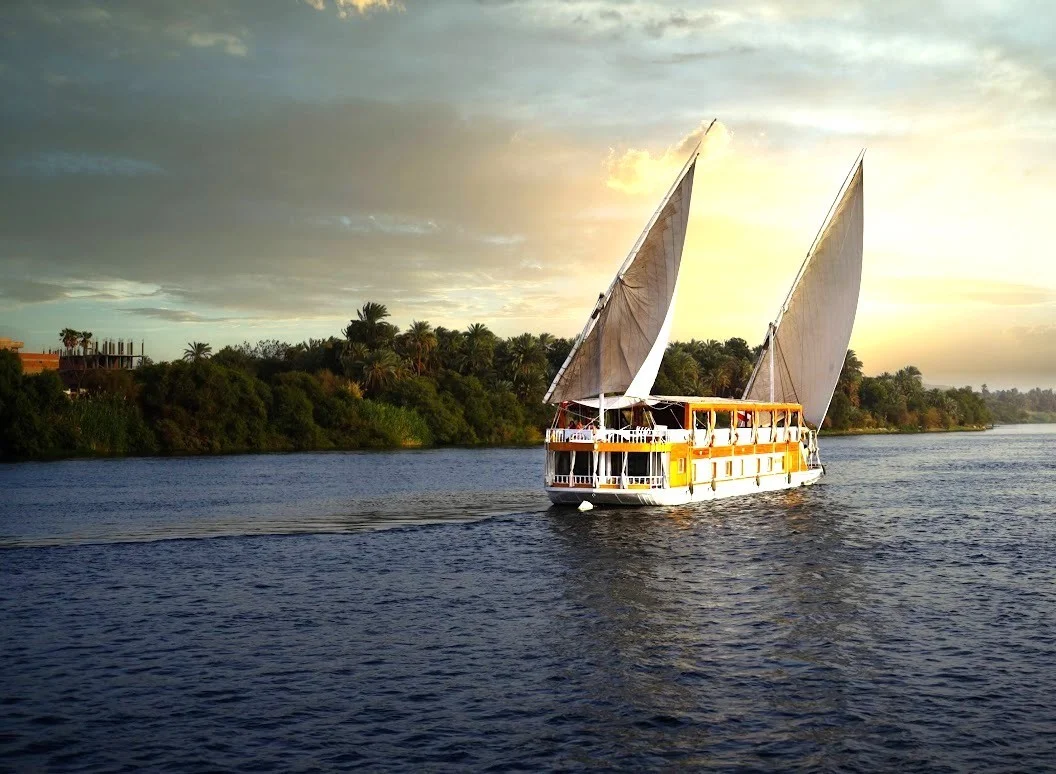
If you want to see the river and the temples from the water, a multi-day trip on a traditional sailing boat is one of the most relaxing ways to do it. A Dahabiya Nile Cruise moves at a slow pace, which gives you time to set up shots from the deck as villages, date palms, and fishermen pass by. Dawn and dusk are the best windows, and the boat itself makes a good foreground element when you want something more personal than a standard landmark photo.
Practical tips for photographing Egypt
- Go early or late. Midday light is flat and harsh at most sites, and the heat makes long shoots difficult.
- Check ticket rules before you go. Some sites charge extra for cameras, and some areas, including the interiors of certain tombs, restrict photography altogether.
- Bring a polarizing filter. It helps with the glare off the Nile and the pale limestone of the temples.
- Keep a spare battery. Cold nights and long exposures drain batteries quickly, and charging points are not always convenient.
- Ask before photographing people. A smile and a short question go a long way, and many locals are happy to be part of the frame.
Egypt rewards photographers who slow down. Give yourself a few extra minutes at each site, watch how the light moves across the stone and water, and you will come home with pictures that look nothing like the postcards.


